Unit1
Unit2
Unit3
Unit4
Unit5
Unit6
Unit7
Unit8
Unit9

UNIT 1

SCHOOLWORK!

MY FUTURE FAMILY

During class, I had sketched up an idea of my ideal family as follows:

  • A nuclear/childless family (I know, stereotypical family but I just love my girlfriend and possibly, just possibly my possibly future children so much)
  • Me, my girlfriend (hopefully wife), probably kids but I wouldn’t wager on that, as well as a golden retriever, a cute orange single-braincelled cat.
  • A decently-sized house with no bastardly HOA
  • Enough finances to comfortably live and buy (a little of that glamour, that champagne, that bougie) without worries.
  • We all have a sense of trust within each other
But when I got home, I’d added to that mental list these points
  • Ideally we’d have a goated gaming PC rig
  • There would be a normal fridge+freezer and one solely for meats because I absolutely would DEVOUR that stuff
  • A pantry full of ingredients because I want to try out difficult recipes.
  • CHORE MEMO

    Hello my lovely family

    Since I was put in charge of the chores by the almighty (Mom), I am here to organize your chores.

    But first I would like to point out what's wrong.

    • Brother, your room is absolutely horrid.
    • The pantry reeks of leftover, half-rotten pasta sauce
    • The trash bins are on the brink of eruption. If you leave it for one more day I swear Ho Chi Minh City will turn into ancient Pompeii
    • The laundry isn't bad, we just forgot to do it.

    So here is what I will assign each person to do:

    • Me: I will cook for the family for the day, as well as do the laundry.
    • Brother: You clean up your own room. I swear I have probably told you like thrice already but whatever.
    • Dad: Please clean up the pantry. It really smells of mom's pasta… Besides, mom will be doing the most difficult task so…
    • Mom: Take out the trash pretty please… I think you are the only human being that can withstand the smell for more than three femtoseconds.

    Please remember to do your assigned tasks. If you don't do it then I legally can't do anything except for you Brother, so I rely on your goodwill. Thank you.

"Somebody has to protect the family from the man that protects the family." - Skyler White yooo"

Personally, I haven’t paid much notice to the concept of family or anything related of the sort before this unit. Sure, I knew of all the modern types: Nuclear, extended, same-sex, single parent, childless. But I never cared to think deep into it, they just existed as meaningless categorizations. That is, until I was prompted to think by the unit.

Premise-wise, the unit was simple (I think, I don’t know my standards are f—ed up). It talks about the different forms of family, what family is, chores, tasks, and intrafamilial relationships. Yet what struck me the most was the question:

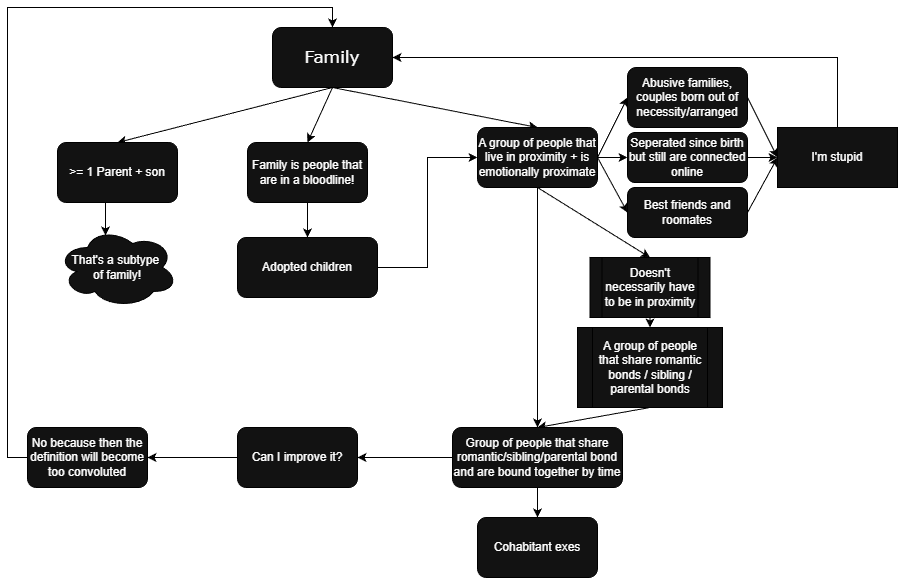
What is Family?

I thought — initially — “This question is pretty simple!”. Yet, as I pondered on it further, the question grew on me more and more. I ran into roadblock after roadblock when I was doing the mental gymnastics to figure out the question

huh. a picture...
i ran in circles trying to answer this question, it was not good.

It wasn’t too tough, but I had a lot of fun questioning myself and my own existence.

Then, I had a shower thought moment — How would I approach this scientifically? Instead of looking at just human families, I decided to look outwards, to nature. And that’s how the idea of my essay: Formation of human families and their history was made.

All in all, I felt pretty enlightened, to say the least, after learning this unit. Though I would have preferred it better if the unit was more heavy on the semantics — it would’ve helped us think more about “family” as a concept rather than just a meaningless categorization.

UNIT 2

SCHOOLWORK!

Present an idea to reduce litter and energy waste in your classroom (100-150 words)

I would like to establish a "Environment sigma” group. A small team is tasked with checking lights, fans, and air conditioning at the beginning of each week to ensure they are only used when necessary. Additionally, the same group keeps an eye on the trash cans and encourages students to properly sort paper, plastic, and other waste. The class can make it enjoyable by tracking its weekly progress on a poster and rewarding itself when objectives are reached, like cutting down on paper waste or keeping the room tidy for a few days.

An environmental issue that I choose: Acidification of ocean waters

Over three billion lives depend on the ocean to survive. That’s 37% of the world’s population. And although we — the general population — are largely aware of the problems that inhabit our waters, such as enormous waste deposits and marine life death from microplastics and macroplastics; there is still a large predicament that most of us are not fully aware of: acidification of seawater. In this essay, I will proceed to introduce the concept of acidification; what are its effects on the ocean, and by extension humanity; as well as if there are any potential solutions that humanity can carry out.

Ocean acidification refers to the gradual decrease in seawater pH, primarily caused by the ocean absorbing excess carbon dioxide from the atmosphere. As human activities — especially the burning of fossil fuels, large-scale industrial processes, and deforestation — release CO2, the ocean takes in roughly a quarter of these emissions, forming H2CO3 (carbonic acid). This acid then dissociates into an HCO3- ion and an H+ ion, with the H+ ion being the one responsible for acidification. It can also originate from SO2 emmisions, which combines with water in the atmosphere or in the ocean to form H2SO3/H2SO4, a very toxic and acidic acid.

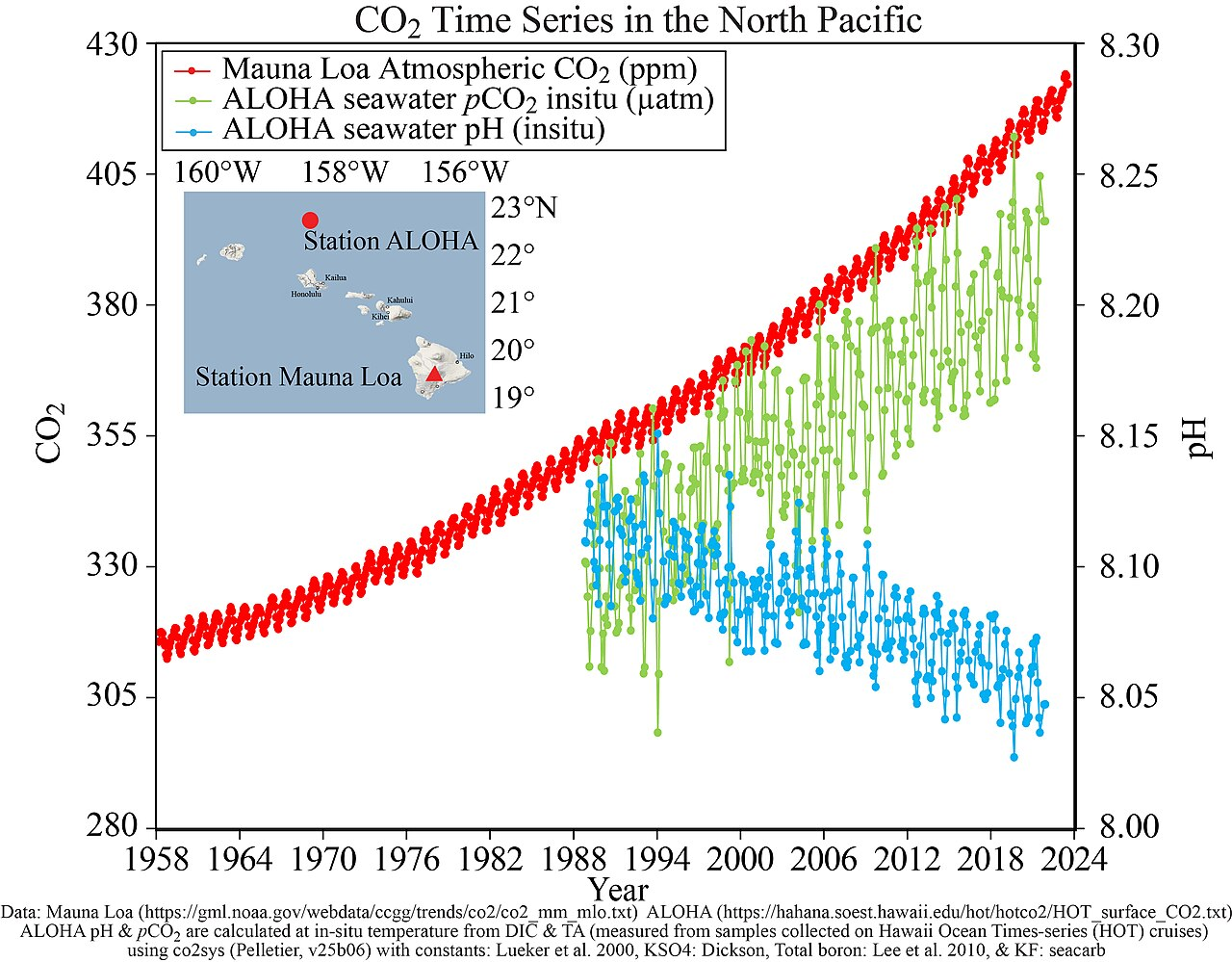
Oceanic pH levels have dropped by about 0.1 — from 8.15 in 1950 to 8.05 in 2020 [1]. That may seem negligible, until you remember that the pH scale is logarithmic. A 0.1 decrease actually represents a 23% increase in the concentration of hydrogen ions in seawater. The situation is even more concerning for surface-level ocean water, where most CO₂ dissolves. From 1980 to 2020, surface pH has fallen by approximately 0.2–0.27.

huh. a picture...
Fig 1: Correlation between atmospheric CO2, dissolved CO2, and oceanic pH at Mauna Loa, Hawaii (Source: By NOAA Pacific Marine Environmental Laboratory Carbon Group - https://www.pmel.noaa.gov/co2/story/Quality+of+pH+Measurements+in+the+NODC+Data+Archives, Public Domain, https://commons.wikimedia.org/w/index.php?curid=142403677)

The consequences of this process stretch far beyond the ocean itself. Acidification firstly weakens coral reefs, and generally animals with an exoskeleton. Hard-shelled animals mainly rely on Calcium Carbonate (CaCO3) — a hard, tough mineral that helps build the foundation for the majority of skeletal structures. Increased dissolved carbon dioxide causes difficulty in absorbing the Carbonate ions (CO3 2-), as well as dissolving trace amounts of CaCO3 from the skeletons themselves. Specifically for corals, the formation of their exoskeleton relies heavily on the concentration gradient between the inner compartments of the coral and outside. Corals need more CaCO3 within the seawater (specifically the mineral aragonite) in order to crystallize the CaCO3 into their exoskeleton. Furthermore, marine life may develop hypercapnia (elevated levels of carbon dioxide in blood). A 2008 study by Rosa and Seibel on the giant squid population has observed that increased CO2 levels in deep sea waters slows down their metabolism [3]. Because humanity relies on the ocean not only for food but also for livelihoods, climate regulation, medicine, and cultural value, the impacts ripple outward into coastal economies, global fisheries, and even climate stability. Coastal cities have begun to observe more undesired catch (post-mortem catches) as well as lower yields of fresh fish, as well as Arctic fishing — where corals and deep sea creatures are the base of the food web.

Yet despite the severity of the issue, ocean acidification remains one of the least publicly understood environmental threats. This lack of awareness hampers global efforts to address it. However, there is one simple, yet very difficult solution to this problem: reduce CO2 and SO2 emmisions. Since the majority of acidification is caused by CO2 dissolving into the water or H2SO4 acid rain, we must address the issue by its root. However, until humanity abandons its hubris and greed, the likelihood is low.

References

[1]. Terhaar, Jens; Frölicher, Thomas L.; Joos, Fortunat (2023). "Ocean acidification in emission-driven temperature stabilization scenarios: the role of TCRE and non-CO2 greenhouse gases". *Environmental Research Letters*. **18** (2): 024033. [Bibcode](https://en.wikipedia.org/wiki/Bibcode_(identifier)):[2023ERL....18b4033T](https://ui.adsabs.harvard.edu/abs/2023ERL....18b4033T). [doi](https://en.wikipedia.org/wiki/Doi_(identifier)):[10.1088/1748-9326/acaf91](https://doi.org/10.1088%2F1748-9326%2Facaf91). [ISSN](https://en.wikipedia.org/wiki/ISSN_(identifier)) [1748-9326](https://search.worldcat.org/issn/1748-9326). [S2CID](https://en.wikipedia.org/wiki/S2CID_(identifier)) [255431338](https://api.semanticscholar.org/CorpusID:255431338). Figure 1f

[2].  Canadell, J.G., P.M.S. Monteiro, M.H. Costa, L. Cotrim da Cunha, P.M. Cox, A.V. Eliseev, S. Henson, M. Ishii, S. Jaccard, C. Koven, A. Lohila, P.K. Patra, S. Piao, J. Rogelj, S. Syampungani, S. Zaehle, and K. Zickfeld, 2021: [Chapter 5: Global Carbon and other Biogeochemical Cycles and Feedbacks](https://www.ipcc.ch/report/ar6/wg1/downloads/report/IPCC_AR6_WGI_Chapter05.pdf) [Archived](https://web.archive.org/web/20220727145459/https://www.ipcc.ch/report/ar6/wg1/downloads/report/IPCC_AR6_WGI_Chapter05.pdf) 27 July 2022 at the [Wayback Machine](https://en.wikipedia.org/wiki/Wayback_Machine). In [Climate Change 2021: The Physical Science Basis. Contribution of Working Group I to the Sixth Assessment Report of the Intergovernmental Panel on Climate Change](https://www.ipcc.ch/report/ar6/wg1/) [Archived](https://web.archive.org/web/20210809131444/https://www.ipcc.ch/report/ar6/wg1/) 9 August 2021 at the [Wayback Machine](https://en.wikipedia.org/wiki/Wayback_Machine) [Masson-Delmotte, V., P. Zhai, A. Pirani, S.L. Connors, C. Péan, S. Berger, N. Caud, Y. Chen, L. Goldfarb, M.I. Gomis, M. Huang, K. Leitzell, E. Lonnoy, J.B.R. Matthews, T.K. Maycock, T. Waterfield, O. Yelekçi, R.

[3]Rosa, R.; Seibel, B. (2008). ["Synergistic effects of climate-related variables suggest future physiological impairment in a top oceanic predator"](https://www.ncbi.nlm.nih.gov/pmc/articles/PMC2634909). *PNAS*. **105** (52): 20776–20780. [Bibcode](https://en.wikipedia.org/wiki/Bibcode_(identifier)):[2008PNAS..10520776R](https://ui.adsabs.harvard.edu/abs/2008PNAS..10520776R). [doi](https://en.wikipedia.org/wiki/Doi_(identifier)):[10.1073/pnas.0806886105](https://doi.org/10.1073%2Fpnas.0806886105). [PMC](https://en.wikipedia.org/wiki/PMC_(identifier)) [2634909](https://www.ncbi.nlm.nih.gov/pmc/articles/PMC2634909). [PMID](https://en.wikipedia.org/wiki/PMID_(identifier)) [19075232](https://pubmed.ncbi.nlm.nih.gov/19075232).

"I think therefore I am. I am. I AM" - AM, probably.

I used to be really interested in environmental protection. Ranging from local topics, such as the blackening of local canals, to wider topics such as the eutrophication of seawater (I was esp. interested in ocean-related phenomenons). However, when I got into 6th grade, my interest dropped. I began to rot away grinding Osu! and Prosekai, and I eventually forgot to polish my skills (e.g. I fell the hell off).

As such, when the subject of environment came up in the curriculum, I felt compelled to revisit my past. I decided to invest my time, and was unfortunately thrashed by how rusty I was. Words couldn’t flow off the tip of my tongue, ideas were harder to catch than an oiled up fugitive running amok in 1936 America’s cornfield.

huh. a picture...
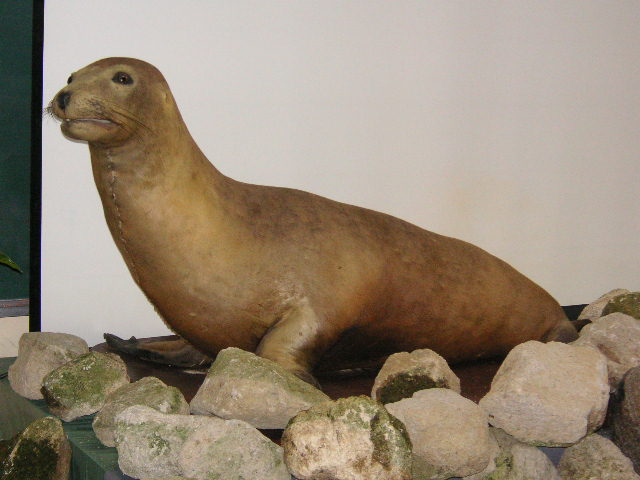
See how cute this feller is? He’s a seal. He’s a cute seal. He’s a cute seal that’s BEEN DEAD FOR OVER FIVE DECADES BECAUSE OF OUR SPECIES' IGNORANCE AND GREED. I just wanted to put this here.

Personally, I would’ve like problems that are discussed in the class to have more depth. Instead of “rising emissions / climate change” I feel like posing a small subproblem would be more suitable. For example: Rising CO2 levels impairs the world on many different levels, one of them would be the ocean. And it affects the ocean by acidification, making seawater acidification a corollary of rising CO2 levels. Thus, the subject is more condensed, with one root cause and clearly defined effects.

Otherwise, great unit!

UNIT 3

"indentured servitude" — Grandma
ONE HELL OF A YAP SESSION

So a bit about my music tastes (a recap is in my about me)

Currently, I listen to a diverse selection of music, though it doesn’t mean I’m not picky. I listen to

- Rock / Soft Metal (I have completely reformed from my Heavy Metal/Deathcore days please do not remind me of them please I cringe so much when I reminisce) → I’m a simp for Serenity and Avenged Sevenfold

- Vocaloid (oh my lord I love Vocaloid so much) Fav artists in no particular order: - neru - Luschka - Kanaria - hachi - Ado

- Rap music: Tbh Kendrick Lamar just carries the whole genre you gotta admit it

- R&B music: I just love Bill Withers, especially his “Just the Two of us”. Comforted me in tough times, I just feel an emotional bond with it

- Classical (by weak extension instrumental): I love both the calming side of classical (Debussy) and also the powerful side (Chopin, Liszt,…). It just tickles that unreachable part in my movie brain.

- Anime + Movie OST: What can I say? Absolute perfection, love it, chef’s kiss mwah mwah. I became addicted to the Detective Conan OST when I was 8, stuck with me til now!

Music that I feel neutral about

- Phonk: It’s really annoying.

- Hip-hop: There are some bad worms that really spoil the genre so that’s the problem, otherwise decent genre that I can get along to, just not a daily driver for me.

Music that I absolutely detest:

- Vietnamese modern music + bolero: I don’t know why but it just hits a hate switch in me, a hate that is much more primal than anything I have. More primal than stubbing my toe twice consecutively and even more than accidentally drinking an expired milk carton.

- Most “white girl” music: It just feels way too stereotypical and unfun to listen to. Bores and annoys the hell out of me.

- Black Metal, Deathcore: At first, I loved it. But eventually it just dawned on me how bad it was (to my own tastes).

- Beatbox: It just pmo so much (no reason that I am aware of)

huh. a picture...
Huh.
huh. a picture...
Bonus image. Huh.

UNIT 4

“The right man in the wrong place can make all the difference in the world.” – Half Life 2

Unit 4, had a pretty promising premise, though I believe it could’ve been explored more philosophically in order to become more interesting. It’s still a really awesome unit don’t get me wrong.

To be honest, I’d never really liked group/community projects (ooh social interactions my goddamned worst nightmare). Group activities feel so inefficient and unorganized. Sure, the occasional project is fine and dandy — also fun if I have good teammates. But anything more than three group/community projects a month and I somersault off of Niagara Falls and nobody sees a trace of me again. The situation has improved, luckily. I can sustain many projects as well as run like a madman against an ever-so-quickening deadline, much better than before so I don’t hate projects as much (I guess), it’s just that I hate the social aspects a lot.

However, the unit is … unexpectedly bringing me some intrigue. The story about Afroz Shah was great (though I would’ve loved to see a famous person as an example, as the fame would have more impact on the students) and I took the time out to really ponder. However, since I had already had a WIP (Unit 2 essay) and I needed to start locking in for the Dự tuyển Olympic test (I will maul myself if I don’t get in), I didn’t have time to start another long research essay.

Overall, good unit, bad timing, please don’t ingest battery acid it’s concentrated and purified DEATH. I am speaking from experience.

There's nothing. Why are you still here?

UNIT 6

“You can't respect without supporting, and you can't support without respecting." - me.

Right, gender equality, where do we start? Let us start with a bit of a personal rant.

I haven’t always actually been such a staunch supporter of gender equality, and even more so when it came to more non-traditional identities. I remember clearly that I was one of those annoying kids who kept talking about “boy versus girl” and “oh boys suffer more because of something something.”. Then came COVID, which brought along the “sigma/alpha” toxic masculinity trend. And naturally, I gravitated towards these flashy, cool edits of men being downright abusive to women and these very cherry-picked portrayals of the LGBTQ community.

Sure, I changed. There was no set point where I’d say I changed for the better, really. Looking back, it’s honestly a bit cringe to think about. That "sigma" mindset is designed to prey on insecurity, especially for estranged young boys, which it absolutely did for me.

When I started actually interacting with the people I once shunned, it was revelatory. I met women who were brilliant, funny, and navigating challenges I had completely overlooked in my "hurr durr boy > girl hurr durr" phase. I met queer individuals who weren't the exaggerated, cherry-picked caricatures the internet fed me. Really, they were just regular people, trying to live authentically, study, work, and be happy. It wasn’t easy. Even though I could feel their authenticity, their ethics and morals, and their existence, the fight against years of inculcation stood tough.

I know, being an advocate doesn't mean I have it all figured out. I still have biases, still have difficulties in understanding some people’s struggles. Sometimes I still catch myself having a knee-jerk reaction or feeling a flash of defensiveness when a blind spot of mine gets pointed out. But instead of leaning into that defensiveness or doubling down, I try to hit pause. I have to actively ask myself why? Why did I do that? It shears away at my pride and ego (I admit that I have a big, big ego. Huge, in the words of Orange Weasel), but I swallow it up and do it. I think, frankly, I have become a slightly better human being!

Enough of that. Now to the unit. Frankly, I hated it. This felt like an insult to my existence and what I stand for. The way this unit tried to talk about gender equality was nothing more than virtue signalling. I am not kidding in any way. It is both shallow and incomplete. Let me quote PTU on this.

“in the literal first text of the unit: ' We're so lucky to be living in a country where everyone can do the job they want, ' that's the BARE MINIMUM. Why are you trying to use what is essentially a basic human need as proof that you are above any other nation?”

The whole unit feels extremely impersonal and vague. Sure, the stories of the first female astronaut are… well… something, I guess? But then again, who gives a damn? It does NOTHING to convince misogynists into changing, and maybe REINFORCES THEIR BELIEFS by sounding so pretentious and misconstrued as teaching material. And the way the unit subconsciously separates men and women. It’s always “oh, I am a girl working a man's job”. IT SHOULD HAVE NEVER BEEN A DISCUSSION IN THE FIRST PLACE. NO, IT DOES NOT WORK LIKE THAT. AND WHAT IS UP WITH THE OVEREMPHASIS ON JOBS? Do people not realize that discrimination runs deep and throughout life, that talking about professions will almost certainly NEVER resolve anything?

No mention is made about the root causes, spread, or history, either. It’s like mentioning kids about malaria, without telling them about mosquitoes, blood transmission, and death tolls. It’s mindboggling! Sure, an oblivious reader would know that these events happen, but without justification, why care? Why fret over the thought of women being discriminated against when they don’t know how misogyny is spread, how it is categorized, and WHAT CAN WE DO? WHAT CAN WE DO??? Oh, the problem is there! Now you know of the problem. Go suck it up and bear the consequences while we tell you NOTHING about resolving it. HAHAHHAHAHAHAH says the Ministry of Education.

And what also finds my rage and anger is the literal omission of LGBTQ+ people. Like, why? Haven’t we learnt already? Decades, centuries of activism just for the MoE to go poof, into oblivion. What stupidity. This just shows how much of a virtue-signaller they are. Trying to put “gender equality” as a unit and never mentioning one of the most marginalized populations in their country, as a means to stay “politically correct” in this country of discrimination and torment. How pernicious.

These people suffer the accusations and tarnishment of others in face of their success. TIM CAIN, THE DEVELOPER OF FALLOUT (LITERALLY ONE OF THE MOST RECOGNIZED AND BEST GAMES OF ALL TIME) WAS DISCRIMINATED BY HIS OWN LABEL AND WAS THE SUBJECT TO HARASSMENT FROM INTERNET TROLLS WHEN HE GOT MARRIED TO HIS HUSBAND.

Here, I quote some of the horrible things that he mentions being said when he got married in an interview.

"The AIDS epidemic was rampant. You were basically told if you're a gay man, you're going to die. And that terrified teenage me, but also it kinda shaped my whole career, because I never really had a role model. [...] Because almost everyone gay, who was older than me, was dead."

"I came out. [...] But I didn't tell this to publishers, because now that I own a company in my mind the worst thing would be to come out and possibly not get deals from publishers, because I was an openly gay developer."

"I got married [...] I changed my facebook status that night. My wikipedia page [...] was defaced. My occupation was changed from developer to homosexual. There were whole forums discussing whether or not my games were still worth playing. [...] And this is a great thing to read when you're on your honeymoon."

I won't call names, but I am willing to wager that the majority of people reading this are homophobic by default, and use the word "gay" as an insult. Adios!

UNIT 7

“The right man in the wrong place can make all the difference in the world.” – Half Life 2

Uh… SUPER unremarkable unit for me, I didn’t give a flying damn about it before, and nothing changed coming out of it. I don’t know, I just don’t give too much attention to these kinds of information, even though I am highly interested in world politics. So yeahhhh…..

UNIT 8

"The human brain is lazy" - Me.

Alright… New ways to learn… That’s pretty interesting

I'll admit, for some of the subjects at school (e.g., Biology, Chemistry, History), I usually just cram them. I already have a lot on my hands (sadly) and I can't be bothered to fit these into my schedule, partially because it is so banged up (changes WAY TOO MUCH I SWEAR TO GOD) and also my ever-reducing attention span (I am WAY TOO easily sidetracked unless I prime myself for like 20 minutes, which consumes energy).

Though I do have some interesting points to chime in on subjects like Math, especially for motivated students. As a math major (duh… obviously…), I feel like too many people regard math robotically. Let me explore this deeper with my favourite subarchetype: Combinatorics.

Combinatorics in mathematical olympiads is the study of counting, arranging, and constructing discrete structures to satisfy specific conditions. It doesn't fall under the more well known archetypes (Algebra, Geometry, Number Theory) though there can be some intercrossing. It is well known for requiring more creativity and critical thinking rather than rote memorization or cramming lemmas; as well as being the most open in terms of knowledge.

The problem with many math students is they tend to think of a combinatorial problem as a [insert technique here, maybe double counting, pigeonhole principle] problem. In secondary, many math specialized students learn four key techniques to solving combinatorial problems: Contradiction, Induction, Minima/maxima principle, Pigeonhole principle (you don't need to understand these). And since combinatorics is such a new (and often abstruse) aspect of maths, they tend to lump every problem into one of these four categories. However, a key pitfall arises: These categories are a) Too wide and broad/too narrow and short and b) Useless when evaluating a problem holistically. Contradiction is too wide – it means nothing. EVERY SINGLE PROBLEM can be solved with contradiction BECAUSE IT MEANS BARELY ANYTHING! It helps us present a shorter and more finessed solution, yes, but should it be considered a category? I believe not. The pigeonhole principle is too narrow. It's just a very small-scoped theorem that often comes extremely intuitively. DUDE???

This makes people FEAR combinatorics when I believe there is nothing to fear. It is a very open and creative genre, which means people can explore and generate many beautiful, varying solutions to one problem. It isn't susceptible to bashing like Geometry, nor will it lead you astray like Inequalities. It is beautiful intrinsically, because it is much wider than the other genres.

Anyways enough of my rant! You get a break from my annoying mouth for now.

UNIT 9

“THE ENVIRONMENT AGAIN??? HJEJEHJEJHJEHJEJJEJHJEHJEJ” – QUANDALE DINGLE, probably.
00:00